
It all started earlier in the week when Ken and I were at a local holiday banquet. Ken was tasked with creating a ‘fun’ trivia quiz, and I wasn’t allowed to know anything about it so that I wouldn’t have a leg up on everyone else because I’m very good at trivia–my mind is like if a jukebox had a baby with an encyclopedia and they all had OCD, and also, the jukebox NEVER STOPS PLAYING. At any rate, one of the trivia questions was about Good King Wenceslas from the Christmas Carol.
What year was King Wenceslas born?
640 BCE
907 CE
1595 CE
1853 CE
So I said 1595, since none of the other answers made sense, but the correct answer was 907, and I was confused because they didn’t have saints before, like, the late 900s AD or something, being as there was no Christianity before 0 AD or whatnot, but then Ken pointed out that I had misread the question, that it was his birthdate, not when the song was written, and that CE was the same as AD, but that AD was a religious term and Common Era wasn’t so it was better to use ‘CE’, and then I POINTED OUT that AD is the common vernacular, and I’d had a couple of glasses of wine, KEN. Anyway, my partner Cathy and I did really well on the trivia, despite the dating debacle. And the wine.
Then, the next day, we were talking about it and I remembered why Good King Wenceslas ranks up there with the most stupid carols. Let me break it down for you:
“Good King Wenceslas looked out
On the feast of Stephen”
So he has nothing better to do during a feast but look out the window? Shouldn’t he be hosting the banquet that HE organized?
“When the snow lay round about
Deep and crisp and even
Brightly shone the moon that night
Though the frost was cruel”
That’s some heavy foreshadowing right there. Best to stay inside where it’s warm, but no…
“When a poor man came in sight
Gath’ring winter fuel”
Why wasn’t he invited to the feast? Is it because he’s poor? So classist.
“Hither, page, and stand by me
If thou knows be telling:
Yonder peasant, who is he?
Where and what his dwelling?”
So he just assumes that his servant knows every single peasant? Even more classist. Also, it’s like the way people conceive of Canadians: “Oh, you’re from Canada? Do you know Bob from Kamloops?” Narrator’s Voice: She does. Just like the page, because plot twist…
“Sire, he lives a good league hence
Underneath the mountain
Right against the forest fence
By Saint Agnes’ fountain”
And those are some VERY specific coordinates. Like maybe he’s been there before, probably when the weather wasn’t so shitty, maybe for a barbeque…
“Bring me flesh and bring me wine
Bring me pine logs hither
Thou and I will see him dine
When we bear them thither”
Seriously? We’ve already established that ‘the frost was cruel’ and now we’re going traipsing out in the middle of the night into a blizzard to give a guy, who already HAS WOOD, some MORE WOOD, as well as some FLESH? You couldn’t wait until the morning? So impetuous. Also, who’s carrying all the flesh and wine 3 miles through the snow? I bet you dollars to donuts that it ISN’T Wenceslas.
And then of course, you know the rest. The page almost dies of hypothermia, the king is like ‘Oh, just walk in my footsteps and you’ll be fine, and by the way, don’t drop the flesh and wood,” and we never find out if they get to the peasant’s house.
Me (driving): I’ve never understood the popularity of a song about some sundowning old guy deciding to wander off into a snow storm during a banquet that HE organized and almost killing his page.
Ken (on his phone):It says here that the feast of Stephen isn’t an actual feast. It’s Saint’s Stephen’s day, December 26th.
Me: Yes, I’m aware, KEN. That was just for comic effect.
Ken: It also says here that he wasn’t an old guy. Wenceslas was only 28 when he died.
Me: Only TWENTY-EIGHT?! Well, now it make sense. He wasn’t trying to be charitable—he thought the peasant was getting ready for a party and he wanted to horn in on the action. He was just lonely, and the flesh and wood were weird-ass hostess gifts. He and the page were probably already drunk and like, “Dude, it’s so BORING here in the castle–isn’t this supposed to be a feast day? Let’s find a peasant we can hang with. Don’t worry about your coat—it’s only a couple of miles. If you get cold, you can just…I dunno…walk in my footsteps,” and the page was like, “Cool. Maybe it’s a barbeque.”
Ken: Wenceslas was murdered by his brother.
Me: Honestly? Not surprising.
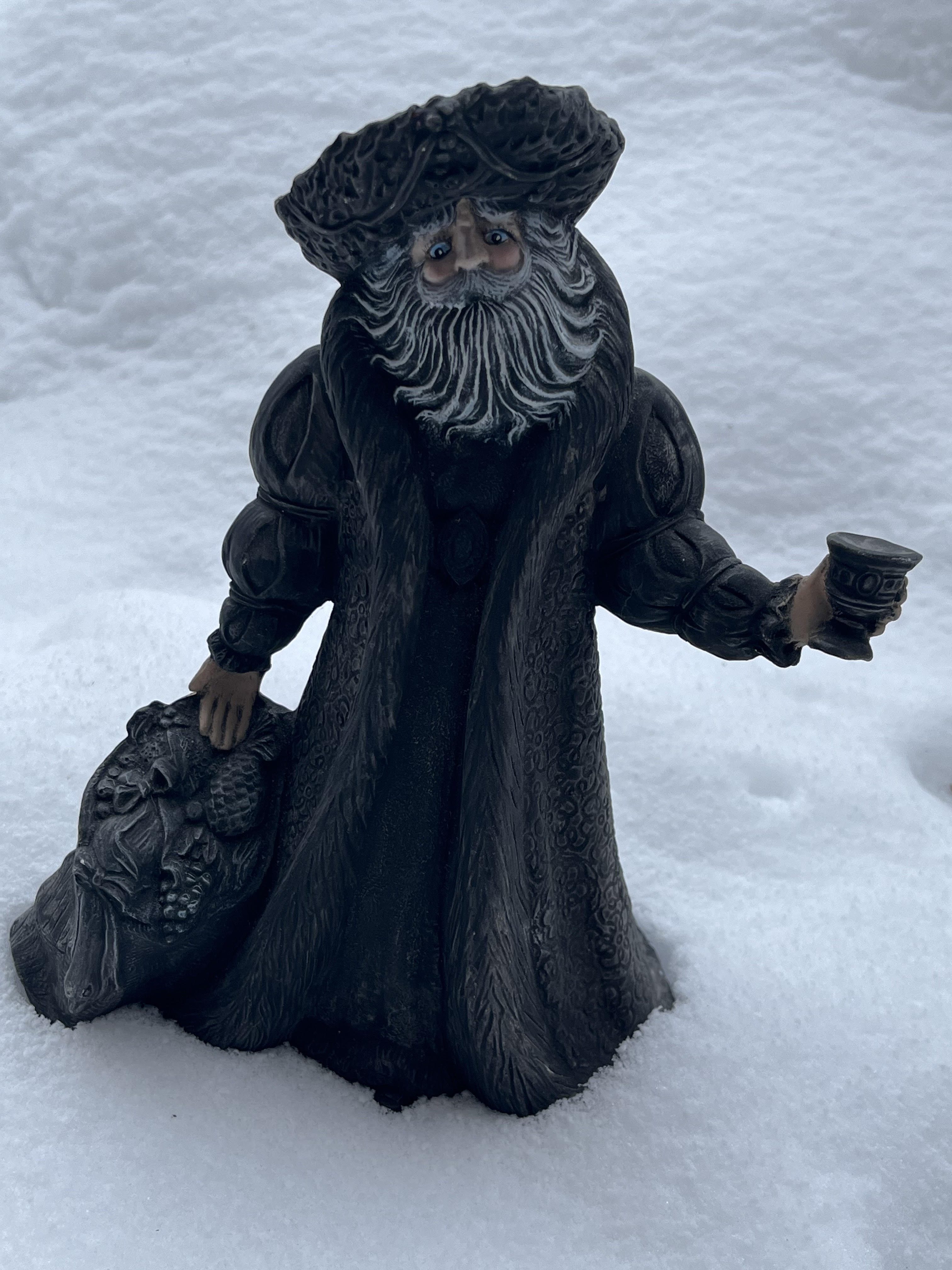
 mydangblog
I’ve often wondered why “Good King Wenceslas” isn’t a more popular carol in the US. There are bits of it in a couple of popular Christmas movies but it just never gets played around here. Well, now I understand why. Also this adds a whole new layer to the scene in “A Child’s Christmas In Wales” when some kids sing it in front of a haunted house.
LikeLiked by 2 people
A lot of them are bizarre when you really start to analyze it. A haunted house is probably the most appropriate thing to include!
LikeLiked by 2 people
Also it seems kind of stingy of “good” King Wenceslas to feed one peasant when he would benefit more by spreading the wealth around.
LikeLiked by 1 person
Yeah, he has lots of flesh, wine, and wood–share the wealth!
LikeLiked by 1 person
I didn’t remember that carol, I just played the Bing Crosby recording. I haven’t heard that since a child. Ken came up with a good one for trivia.
LikeLiked by 3 people
Yes, I thought it was tricky but our kids got it right away!
LikeLike
As a kid I always thought the lyrics were:
“Good king Wenscles last looked out…” (rhymes with pencils). I imagined him constantly checking what was going on outside & the last time he does it he sees the old codger plodding through the snow.
LikeLiked by 3 people
That’s so funny—I did too, for years!
LikeLiked by 1 person
What Claude said about the connection…
—
Yes, they’re the same Stephen! This is St. Stephen, the first Christian martyr, whose feast day is December 26th (the day after Christmas).
**St. Stephen’s Background**
Stephen was one of the first seven deacons of the early Christian church in Jerusalem, chosen to help distribute food to widows. According to the Acts of the Apostles, he was arrested for blasphemy and stoned to death around 34-36 AD, making him Christianity’s first martyr (or “protomartyr”). His feast day, December 26, is called St. Stephen’s Day or the Feast of Stephen in many Christian traditions.
**St. Stephen’s Cathedral in Vienna**
The magnificent Gothic cathedral in Vienna (Stephansdom) is indeed dedicated to this same St. Stephen. It’s been Vienna’s most important church since its consecration in the 12th century and serves as the seat of the Archbishop of Vienna. The cathedral is a symbol of the city itself.
**The “Good King Wenceslas” Connection**
This is where it gets interesting! The Christmas carol “Good King Wenceslas” begins:
“Good King Wenceslas looked out, on the Feast of Stephen…”
The song is set on December 26th, St. Stephen’s Day. In the carol, the Bohemian King Wenceslas (actually a duke, not a king—Wenceslas I of Bohemia, who lived in the 10th century) looks out his window on a snowy St. Stephen’s Day and sees a poor man gathering firewood. Moved by compassion, he and his page venture out into the brutal winter weather to bring the man food, drink, and fuel.
So St. Stephen connects all three: he’s the martyr whose feast day is celebrated on December 26th, the patron saint of Vienna’s great cathedral, and the day when Good King Wenceslas performed his legendary act of charity.
LikeLiked by 1 person
I like the way your mind works!
LikeLiked by 1 person
Thank you!
LikeLiked by 1 person
And now, I know all the words for the next trivia night I might be invited to! Also, the song does have a good beat–almost rivals Drummer Boy.
LikeLiked by 1 person
My favourite is still the Charlie Brown Christmas album!
LikeLiked by 1 person
Christmas used to be fun when the kids were all little. Now it’s just a reason for me to feel guilty that I haven’t cleaned the skirting boards. 😦
LikeLiked by 1 person
Sigh. I hear you❤️
LikeLiked by 1 person
Being myself thirsty for knowledge, I follow a bunch of pages on such stuff. It’s a great chance to learn sth new.
LikeLiked by 1 person
OMGHAHAHAHAH ha! Up to now, I only thought of that song as a catchy tune sung in many parts harmony. Just another gap in my education. But you have gotten me up to speed on that old King W. Trivia is some fun?
LikeLiked by 1 person
I love doing trivia—it’s amazing the things you don’t know that you know!
LikeLiked by 1 person